The Companies with the Biggest Workforce in the Car Industry
The global automotive industry is one of the largest employers in the world, and looking at it through the lens of workforce size tells a story that sales or revenue rankings often miss. Behind every model on the road there are factories, R&D centers, supply chains and dealer networks employing hundreds of thousands of people. Ranking the top car manufacturers by number of employees shows where the industrial weight of the sector really sits and where it's shifting.
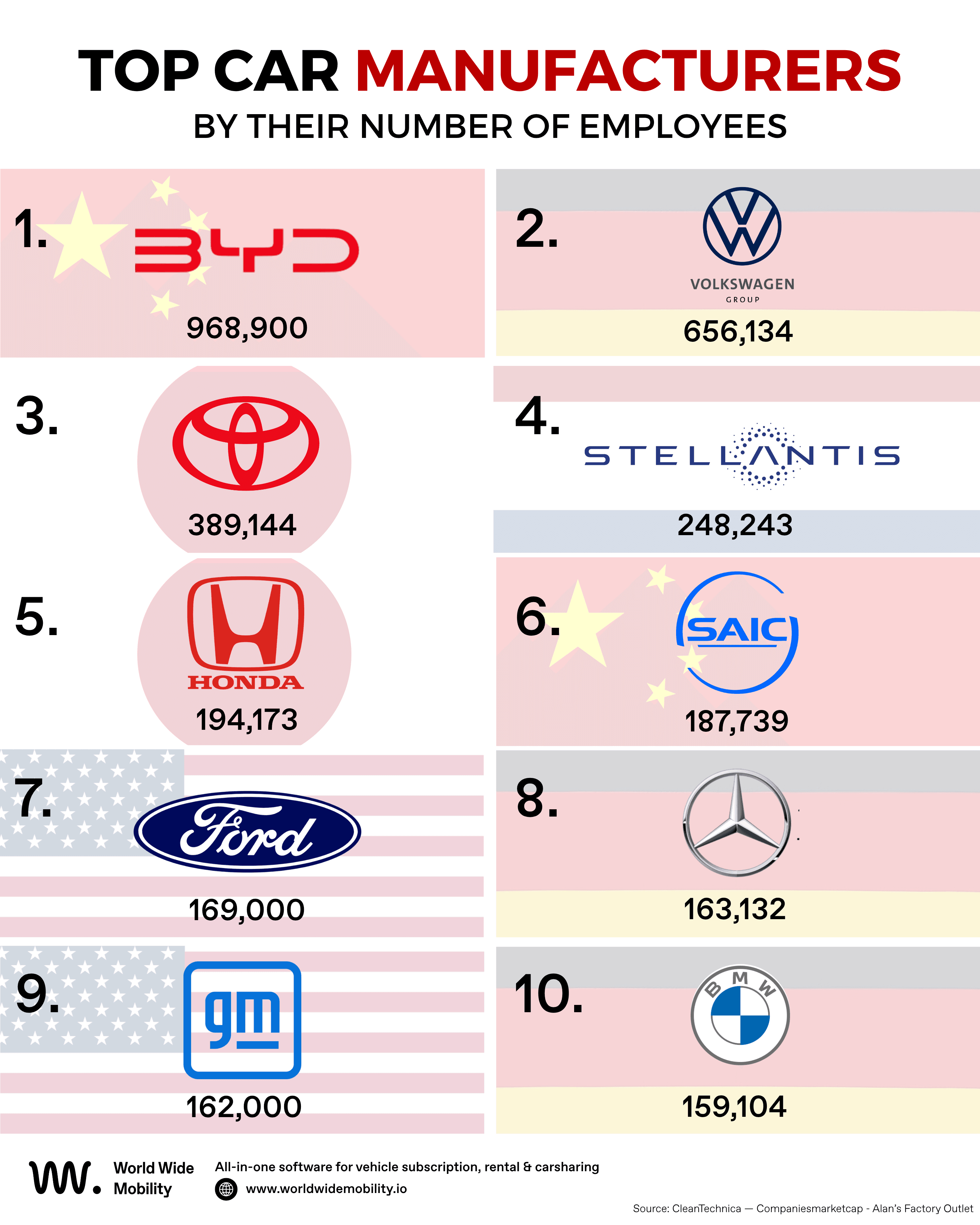
1. BYD — 968,900 employees 🇨🇳
The ranking opens with a name that, just a decade ago, few outside China would have recognized. Founded in 1995 in Shenzhen, BYD ("Build Your Dreams") started as a battery manufacturer before moving into vehicles in 2003. Today it is one of the biggest EV brands in the world and one of the fastest-growing companies in the global auto industry.
Its secret is vertical integration: batteries, semiconductors, electric motors and final assembly are produced in-house. That model, closer to a tech company than a traditional carmaker, explains why its workforce is nearly 50% larger than Volkswagen's, and why BYD is now expanding aggressively in Europe, Southeast Asia and Latin America. Its Blade Battery technology is also licensed to other automakers, making it a key player in the global EV value chain, as we recently covered in our ranking of the most valuable automotive companies in 2026.
2. Volkswagen Group — 656,134 employees 🇩🇪
Right behind BYD sits Europe's largest automaker. Headquartered in Wolfsburg, the Volkswagen Group owns 10 brands across mass-market, premium, luxury and commercial segments: Volkswagen, Audi, Porsche, Seat, Cupra, Škoda, Bentley, Lamborghini, Ducati and Scania.
Its Wolfsburg plant is one of the largest car factories on the planet, and the group is one of Germany's biggest private employers. After the 2015 diesel crisis, VW pivoted hard into electrification with its MEB platform and the ID. family, and is now developing the SSP architecture to power its next generation of EVs.
3. Toyota — 389,144 employees 🇯🇵
Based in Toyota City, Toyota has been the world's top-selling automaker for several consecutive years. It pioneered the Toyota Production System, the origin of modern "lean manufacturing", and its hybrid pioneer, the Prius, opened the door to mass-market electrification back in 1997.
The group owns Lexus, Daihatsu and Hino, and holds significant stakes in Subaru, Mazda and Suzuki. While Toyota was initially cautious on full EVs, it is now scaling its bZ electric lineup and investing heavily in solid-state batteries, a technology it expects to commercialize within the next few years.
4. Stellantis — 248,243 employees 🌍
If BYD is the newcomer at the top, Stellantis is the most ambitious recent consolidation play. Created in 2021 through the merger of Fiat Chrysler Automobiles (FCA) and Groupe PSA, it brings together 14 brands: Peugeot, Citroën, Fiat, Jeep, Opel, Chrysler, Dodge, Ram, Alfa Romeo, Maserati, Lancia, DS, Vauxhall and Abarth.
With headquarters in the Netherlands and operational hubs in France, Italy and the U.S., Stellantis is one of the most multinational carmakers in the world. Its "Dare Forward 2030" plan targets 100% EV sales in Europe and 50% in the U.S. by the end of the decade, an aggressive goal supported by its STLA Small, Medium, Large and Frame platforms.
5. Honda — 194,173 employees 🇯🇵
Founded by Soichiro Honda in 1948, Honda is much more than a carmaker. It is the world's largest motorcycle manufacturer, and produces engines for power equipment, marine use and aviation through its HondaJet division.
Its Acura brand competes in the premium segment, especially in North America. After years of relative caution on full electrification, Honda recently announced a major EV push, including a strategic alliance with Sony to develop the Afeela brand and a deeper partnership with GM on next-generation electric platforms.
6. SAIC Motor — 187,739 employees 🇨🇳
The second Chinese name in the top six belongs to SAIC (Shanghai Automotive Industry Corporation), one of China's "big four" state-owned automakers. SAIC operates major joint ventures with Volkswagen and General Motors inside China and owns brands such as MG, Maxus, Roewe and Wuling (co-owned with GM and one of the largest small-EV producers in the world).
The revival of MG as a global EV brand, particularly strong in Europe, Latin America and Australia, is one of the clearest examples of how Chinese groups are using legacy nameplates to accelerate their international expansion, a trend also visible in the latest best-selling car brands worldwide in 2025.
7. Ford — 169,000 employees 🇺🇸
A short jump across the Pacific brings us to Ford. Founded by Henry Ford in 1903 and headquartered in Dearborn, Michigan, the company famously changed industrial history with the moving assembly line. Today, Ford operates with two main divisions: Ford Blue (combustion vehicles) and Ford Model e (electric), alongside Ford Pro, its commercial vehicle and fleet services business, one of its fastest-growing units.
The F-150, America's best-selling vehicle for decades, now has an all-electric variant (F-150 Lightning), and Ford has invested billions in battery plants across the U.S. as part of its EV transition.
8. Mercedes-Benz Group — 163,132 employees 🇩🇪
Headquartered in Stuttgart, Mercedes-Benz is one of the oldest car brands in the world, with roots going back to Karl Benz's 1886 patent for the first automobile. The group covers Mercedes-Benz cars, Mercedes-AMG, Mercedes-Maybach and Mercedes-EQ, its electric line.
In recent years, Mercedes has refocused on the top-end luxury segment, prioritizing higher-margin models over volume. Its EQS and EQE lineups, along with the new MMA platform, are central to its plan to lead the premium EV race.
9. General Motors — 162,000 employees 🇺🇸
Back to the U.S., General Motors, founded in 1908 and based in Detroit, owns Chevrolet, GMC, Cadillac and Buick. It also controls Cruise, its autonomous driving unit, and has invested heavily in its Ultium battery platform to power its EV transition.
GM has set a target to phase out internal combustion engine vehicles by 2035, supported by its expanding lineup that includes the Chevrolet Equinox EV, Blazer EV, Silverado EV and the Cadillac Lyriq.
10. BMW Group — 159,104 employees 🇩🇪
Closing the top 10, the BMW Group, headquartered in Munich, includes BMW, MINI and Rolls-Royce Motor Cars, plus BMW Motorrad for motorcycles. The company has been a long-standing reference in premium driving dynamics.
Its big bet now is the Neue Klasse electric platform, set to reshape its EV lineup from 2025 onward, with new architecture, in-house 6th-generation batteries and a stronger focus on digital experience and connected services.
What the ranking tells us about the global auto industry
A few patterns stand out. China holds two spots in the top six (BYD and SAIC), confirming how quickly its automotive sector has scaled, especially in EVs and batteries. Europe shows very strong representation, with Volkswagen Group, Stellantis, Mercedes-Benz and BMW placing four groups in the top 10, in line with what we've seen in our review of the top car manufacturing countries in Europe. The U.S. holds its ground through Ford and GM, while Japan stays a heavyweight thanks to Toyota and Honda.
The most striking data point is the gap at the top: BYD alone employs nearly as many people as Ford, GM, Mercedes-Benz and BMW combined. That figure says a lot about where the center of gravity of the industry is shifting and how the EV race, also visible in Europe's electric vehicle share by country, is reshaping not just product lineups, but the very structure of the global workforce.
As mobility and automotive companies grow, technology becomes essential for launching digital services, managing fleets and offering flexible customer experiences. World Wide Mobility provides modular technology for rental, subscription, car-sharing, MaaS and fleet-based services, helping companies digitize and scale their operations.
Source: CleanTechnica, Companiesmarketcap, Alan's Factory Outlet.