The automotive industry remains one of the most reliable indicators for understanding how the global economy, mobility patterns, and consumer behavior evolve worldwide. In 2025, car sales confirm a clear trend: a small number of brands dominate large regions of the world, although with important differences depending on each country, its level of development, and the prevailing mobility model.
In this post, we analyze the best-selling car brands in 2025 by country, using a comparative world map that visually shows which manufacturer leads each market. To better understand how the market has evolved, it is also useful to compare these results with the previous year, as outlined in our analysis of the best-selling car brands worldwide in 2024.
A Quick Look at the Global Car Sales Map in 2025
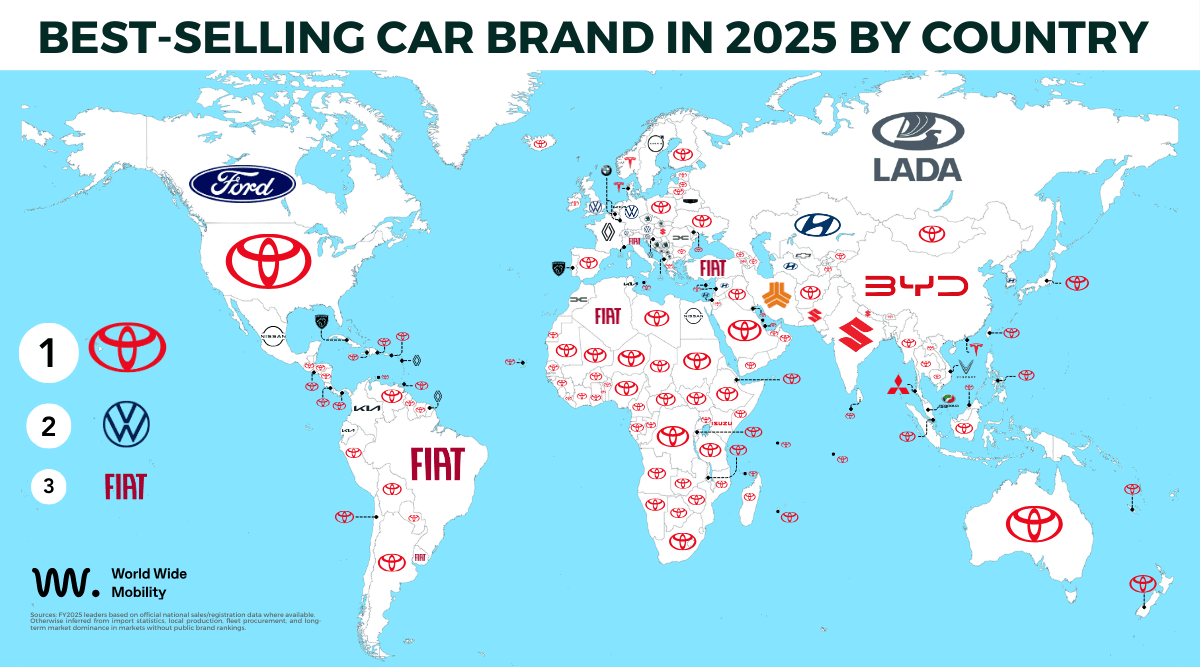
The graphic accompanying this article highlights several clear patterns:
- Toyota is the best-selling brand in most countries worldwide
- Volkswagen maintains a strong leadership position across much of Europe
- Fiat remains key in specific markets in Europe and Latin America
- Ford continues to play a relevant role in North America, especially in Canada
- Asian brands such as Hyundai, Suzuki, and BYD are gaining ground across Asia
- Local manufacturers, such as LADA, continue to dominate very specific markets This distribution is not random. It reflects factors such as price positioning, reliability, distribution networks, local production, and national industrial policies.
Toyota: The World’s Best-Selling Car Brand in 2025
If one brand appears repeatedly across the 2025 map, it is Toyota. The Japanese manufacturer leads sales across much of Africa, the Middle East, Asia, Oceania, and numerous Latin American countries, while also maintaining a strong position in mature markets.
Why Does Toyota Dominate So Many Countries?
The reasons behind Toyota’s global leadership are clear:
- A strong reputation for reliability and durability
- A wide range of models (city cars, SUVs, pickups, hybrids)
- A solid presence in emerging markets
- A competitive advantage in hybrid technologies
- Low maintenance and ownership costs In many countries where a car is both a working tool and a long-term investment, Toyota is widely perceived as a safe and dependable choice.
Volkswagen: A Benchmark in Europe and Developed Markets
In Europe, Volkswagen remains one of the best-selling brands in many countries in 2025, particularly across Central and Western Europe. The German group continues to perform strongly thanks to:
- A product range well suited to European drivers
- A long-standing market presence
- A strong balance between quality, price, and technology
- Leadership in key segments such as compact and family vehicles Despite increasing competition, Volkswagen continues to be a clear reference point in many European markets.
Fiat: Strong in Specific European and Latin American Markets
Fiat maintains its leadership in very specific countries, particularly:
- Italy and parts of Southern Europe
- Selected markets in Latin America Its success is driven by:
- Highly competitive small and urban vehicles
- Affordable pricing
- Local production in several countries
- Strong acceptance in dense urban environments In regions where compact cars remain essential, Fiat continues to play a leading role.
Ford: A Relevant Presence in North America, Especially Canada
In Canada, Ford remains the best-selling brand in 2025, largely supported by its historic strength in pickups and commercial vehicles key segments in North American mobility. In the United States, while Ford continues to hold a strong position in segments such as pickups, the market is more fragmented overall, with Toyota gaining increasing prominence as the leading brand in total vehicle sales, as reflected in the 2025 global map.
Expanding Asian Brands: Hyundai, Suzuki, and BYD
The 2025 map also clearly highlights the growth of Asian manufacturers, particularly across Asia:
- Hyundai stands out in several countries thanks to its balance of price, design, and technology
- Suzuki maintains a strong presence in markets where small cars are essential
- BYD continues to strengthen its position in China and other Asian markets, driven by the rapid growth of electric vehicles These brands reflect a structural shift: Asia is no longer just a production hub it is also leading innovation and global sales volumes.
LADA and the Importance of Local Manufacturers
In Russia, LADA has consolidated its position as the best-selling car brand in recent years, including 2025. This leadership cannot be understood without considering the recent geopolitical context. The reduced presence of international brands, combined with economic sanctions and supply chain disruptions, has reinforced the role of domestic manufacturers. In this environment, LADA has maintained local production and distribution capabilities, becoming the most accessible and readily available option for the Russian market. Beyond political factors, its success is also based on offering simple, robust vehicles adapted to local conditions, which remain decisive factors in purchasing decisions.
What Do the Best-Selling Brands Tell Us About Global Mobility?
The 2025 map reveals several key insights:
- There is no single dominant brand across all markets
- Mobility is deeply connected to each country’s economic and social context
- Reliability and affordability often outweigh pure innovation
- Asian manufacturers continue to gain global relevance
- Local markets maintain very distinct dynamics
The Potential Impact of Chinese Brands on the Global Map
Although Chinese brands do not yet dominate most countries in total sales in 2025, their presence is becoming increasingly visible, and their sustained growth suggests a potential reshaping of the global map in the coming years. Manufacturers such as BYD, Chery, Geely, and MG are rapidly gaining market share thanks to competitive pricing, a strong focus on electric vehicles, and an aggressive international expansion strategy particularly in Asia, Europe, and emerging markets.
This growth becomes even more significant when looking at the industrial structure behind these brands. Unlike a decade ago, many of them are now part of large Chinese automotive groups that bring together multiple brands, technologies, and production platforms. This reality is clearly reflected in our global map of automotive manufacturers, which highlights the scale and diversity of China’s automotive ecosystem.