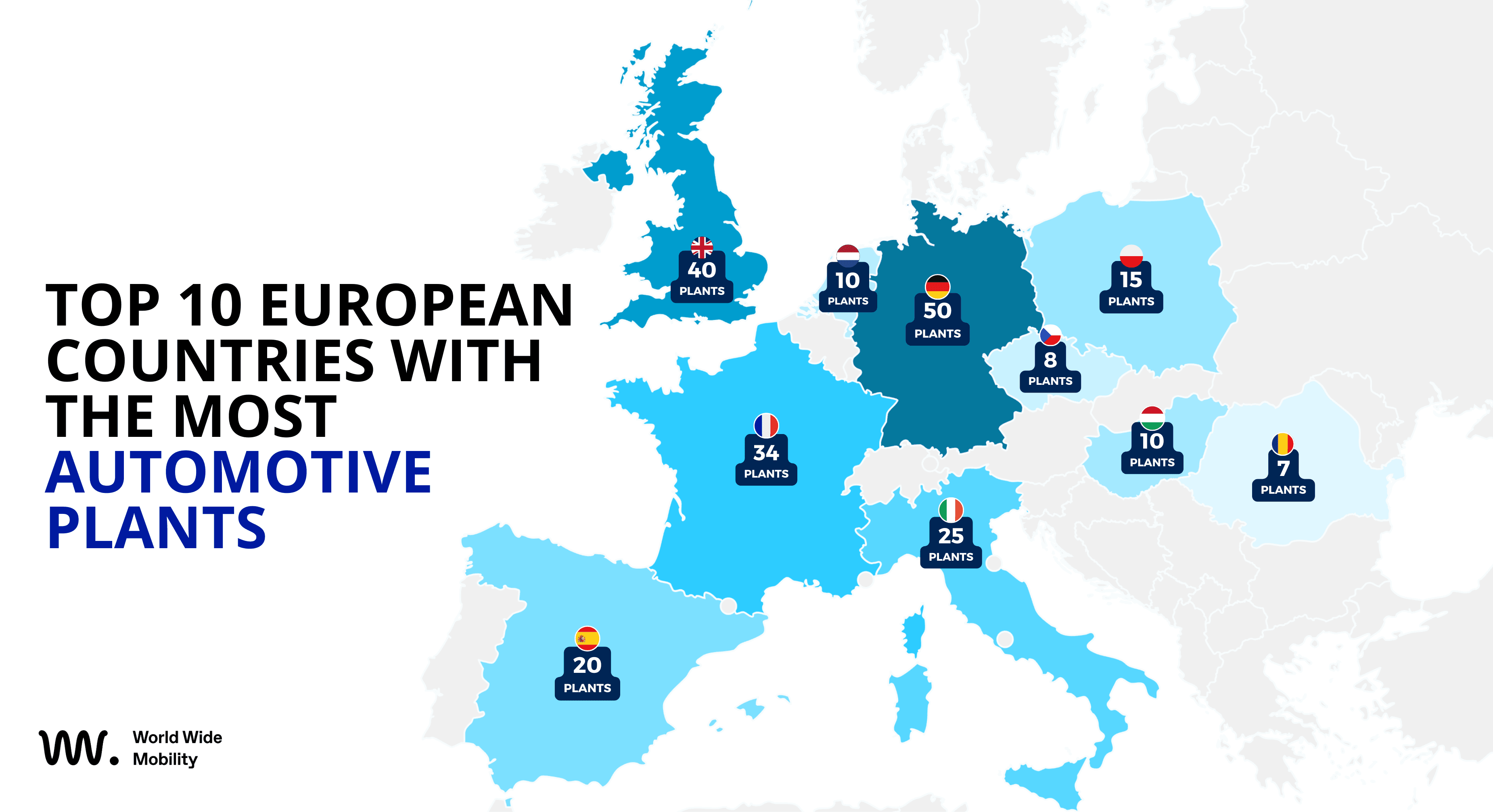
Production volumes get most of the attention, but the number of plants a country hosts says something else: how broad its automotive base really is. Using ACEA's 2025 plant count, published in The Automobile Industry Pocket Guide 2025/2026, we mapped the ten European countries with the most automotive plants.
A quick note on scope. ACEA counts 254 vehicle assembly, powertrain and battery plants across the EU and the UK, from car factories to sites that build vans, trucks and buses. Suppliers, custom bodybuilders and many smaller manufacturers are left out, so the ranking reflects the core of the industry rather than every factory in Europe.
- 🇩🇪 Germany: 50 plants
- 🇬🇧 United Kingdom: 40 plants
- 🇫🇷 France: 34 plants
- 🇮🇹 Italy: 25 plants
- 🇪🇸 Spain: 20 plants
- 🇵🇱 Poland: 15 plants
- 🇭🇺 Hungary: 10 plants
- 🇳🇱 Netherlands: 10 plants
- 🇨🇿 Czech Republic: 8 plants
- 🇷🇴 Romania: 7 plants
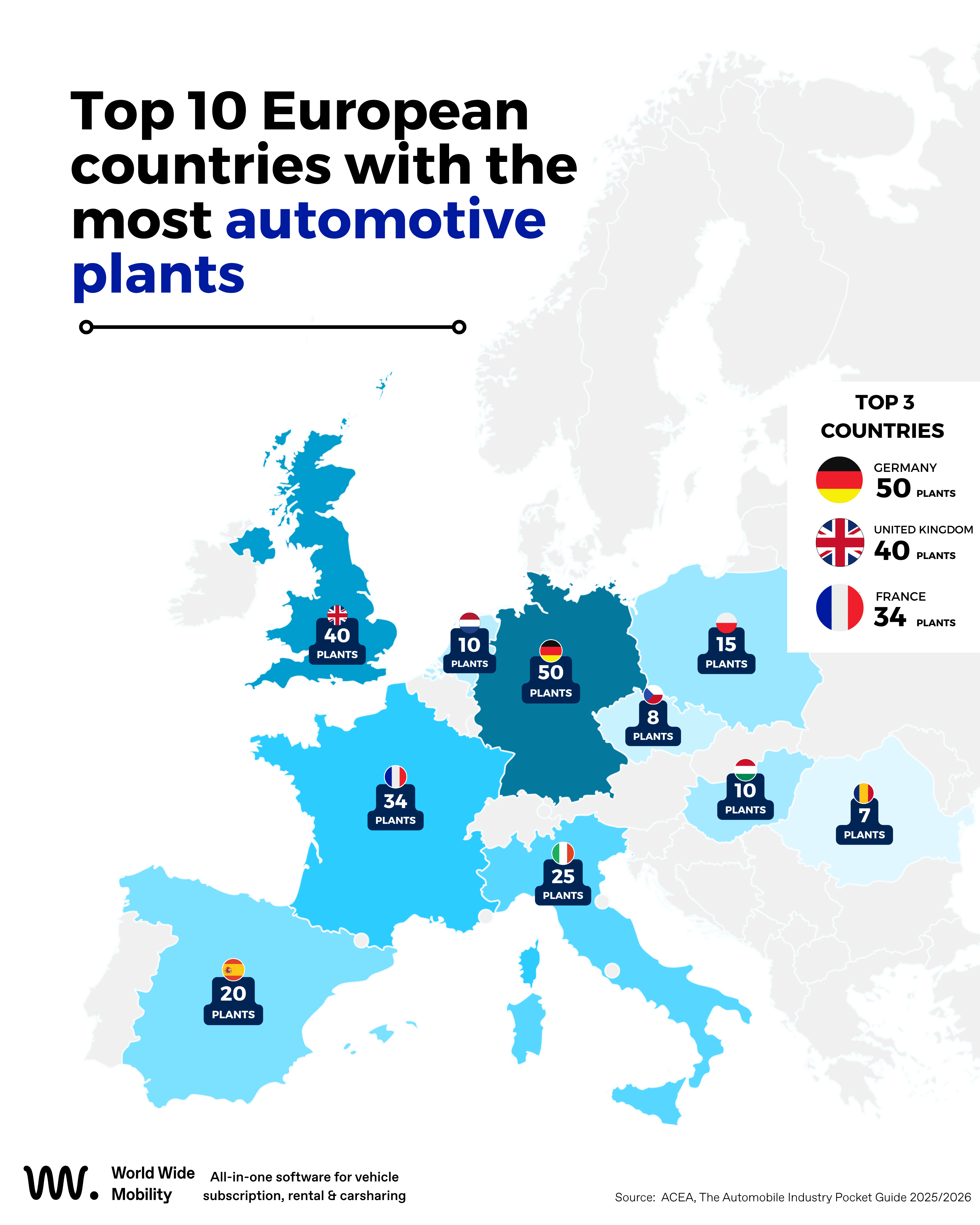
Germany's lead comes as little surprise. The home of Volkswagen Group, BMW and Mercedes-Benz accounts for almost one in five plants in ACEA's count, and 26 of its 50 sites are involved in battery-electric vehicle (BEV) production.
The UK, the only non-EU country in the ranking, comes second with 40 plants, and France completes the podium with 34. Each has 15 plants linked to BEV production. Together, the top three add up to 124 plants, nearly half of the total.
More plants don't always mean more cars
Spain ranks fifth with 20 plants, yet it built 1,872,988 cars in 2024, second only to Germany in the EU, according to S&P Global Mobility data included in the same ACEA guide. The Czech Republic stands out even more: with just 8 plants, it produced 1,446,855 cars, well ahead of France's 849,437. For a closer look at output by country, see our ranking of the top car manufacturing countries in Europe.
The type of plant matters too. Italy has 25 sites but built 309,336 cars in 2024, alongside 224,454 vans and 55,066 trucks. Poland, with 15 plants, was the EU's largest bus producer that year, with 7,019 units.
Europe's automotive map keeps changing
The graphic shows ACEA's 2025 count, but the map is already moving. In its June 2026 update, ACEA puts the total at 260 plants across the EU and the UK. The biggest jump came from battery plants, up from 65 to 76, while sites producing cars dipped from 102 to 100, a sign of how the shift to electric vehicles is reshaping the industry's footprint.
New players are arriving as well. Chinese car brands are starting to build in Europe, with BYD in Hungary and Chery and Leapmotor in Spain among the most visible projects.
Many of the vehicles built in these plants end up in rental, subscription and car-sharing fleets. As those fleets grow and electrify, technology becomes essential for launching digital services, managing vehicles and offering flexible customer experiences. World Wide Mobility provides modular technology for rental, subscription, car-sharing, MaaS and fleet-based services, helping companies digitize and scale their operations.
You may also like: Top Car Manufacturing Countries in Europe in 2025: about the countries that manufacture the most cars in Europe.
Sources: ACEA, The Automobile Industry Pocket Guide 2025/2026 (plant count and S&P Global Mobility production data); ACEA interactive plant map, June 2026 update.