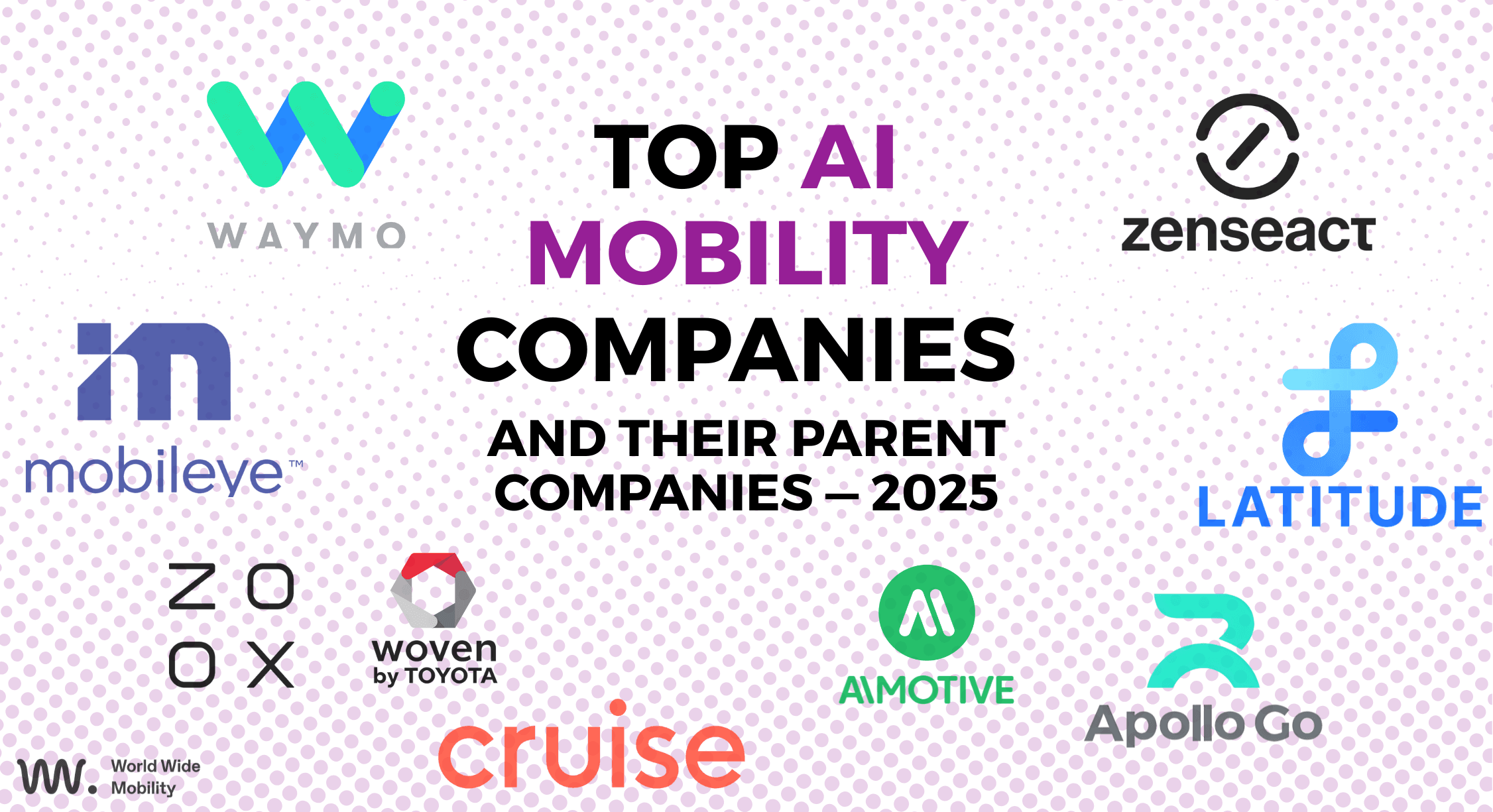
Artificial intelligence is no longer something that “might arrive someday” in mobility. It is already here, reshaping the sector in very real ways, changing how vehicles are built, how fleets are managed, and how we imagine transportation in the years ahead. And if we look at 2025 with a bit of perspective, the most interesting thing is not only which companies are leading autonomy, but who is actually behind them.
The graphic in front of us sends a clear message: the strongest AI mobility companies today are controlled or backed by major tech giants and global carmakers. That means we have moved from an experimentation phase into a strategic race. It is no longer just about proving that autonomy works, but about who can scale it safely, in which cities, under which regulations, and with what operational model.
For corporate mobility and premium ground transportation, this is not theoretical. It affects how business travelers will move, what safety levels companies will demand, and how trust will be maintained in a world where chauffeur driven vehicles, AI assisted cars, and autonomous services will coexist for quite some time.
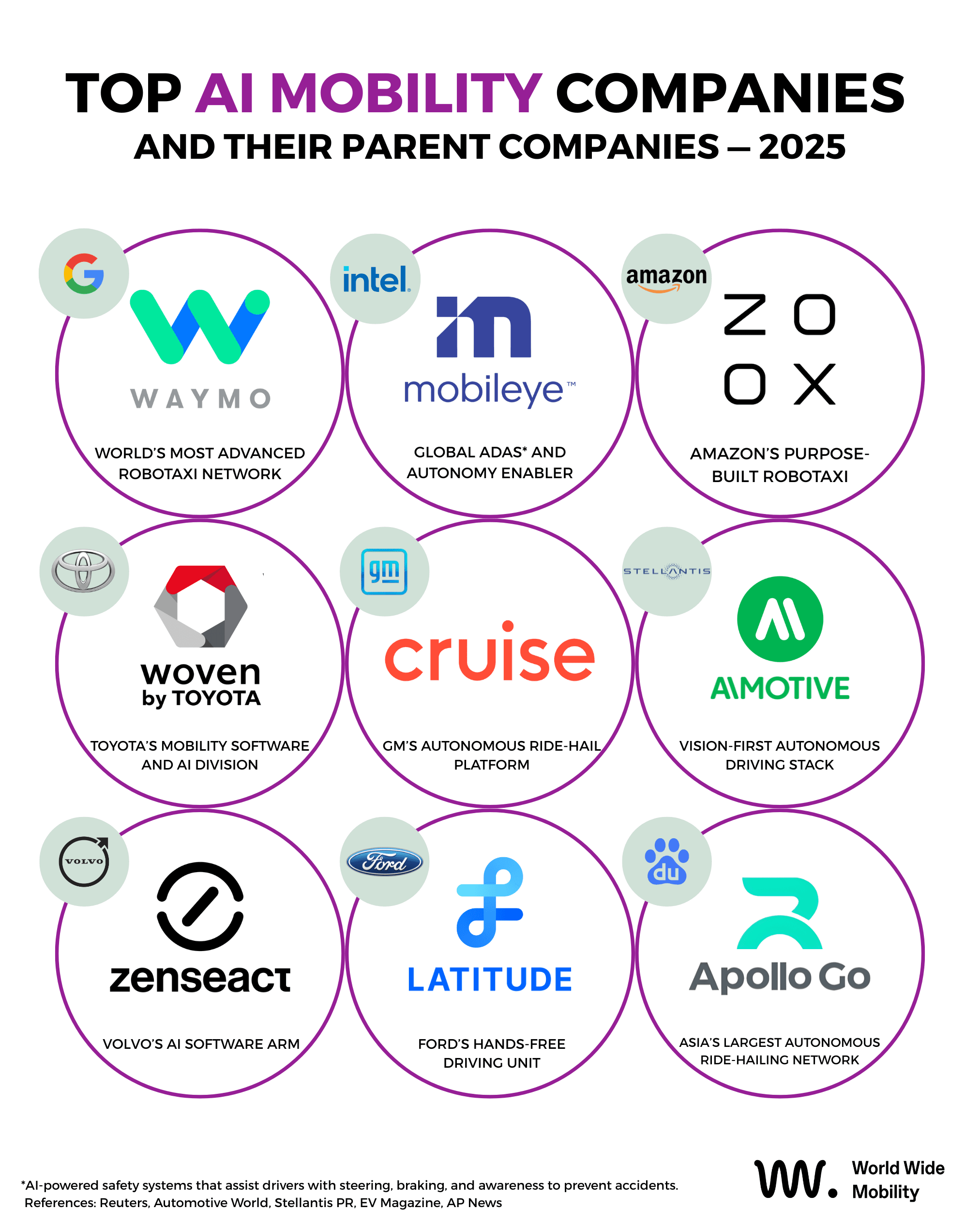
| AI Mobility Company | Parent Company | Focus or what they are known for | Region or scale |
|---|---|---|---|
| Waymo | Google (Alphabet) | Robotaxis and a mature self driving platform with years of real world operation | Mainly the US, expanding |
| Mobileye | Intel | ADAS systems and autonomy technology for automakers, focused on vision and mapping | Global presence across many OEMs |
| Zoox | Amazon | Robotaxi designed from the ground up for autonomous fleet services | US focused, with global ambition |
| Woven by Toyota | Toyota | Software and AI mobility ecosystem, connected cities, and autonomy R and D | Japan and the global Toyota ecosystem |
| Cruise | General Motors (GM) | Urban autonomous mobility and driverless ride hailing programs | US |
| Amotive | Stellantis | Vision first autonomous stack developed inside the group | Europe and Stellantis global network |
| Zenseact | Volvo | Volvo’s AI and software arm, centered on safety led autonomy and ADAS scaling | Europe and Volvo’s global footprint |
| Latitude | Ford | Hands free driving and a pipeline toward full autonomy | US and Ford’s global fleet |
| Apollo Go | Baidu | Large scale robotaxi network, especially advanced in Chinese cities | Asia, particularly China |
Main uses of AI in the mobility world today
When we think about AI and mobility, it is easy to focus only on robotaxis. But the reality is that artificial intelligence is already embedded across many layers of transportation, often in services we use every day without noticing.
One of the most widespread uses today is advanced driver assistance systems, known as ADAS. These technologies help with braking before a collision, keeping the lane, detecting vehicles in blind spots, or monitoring traffic signals and pedestrians. Even though this is not “full autonomy,” ADAS is improving safety right now. At the same time, it generates extremely valuable real world data that will train the autonomous systems of the future.
The second major area is full autonomous driving and robotaxi operations. Here AI must do everything: understand the environment, predict what others will do, plan routes, and control the vehicle without human input. In 2025, the hard part is no longer proving a car can drive itself in a clean scenario. The hard part is making it perform safely and reliably in different cities, with unpredictable traffic, rain, roadworks, pedestrians crossing suddenly, and very different regulatory frameworks.
AI is also reshaping fleet management. Whether a fleet is chauffeur driven or autonomous, mobility networks only work when operations are smooth. Artificial intelligence helps anticipate maintenance needs, forecast demand, assign vehicles intelligently, optimize routes, and respond better when disruptions happen. This is already increasing reliability and efficiency for many mobility companies, even in markets where autonomy is still limited.
Finally, AI is becoming central to traveler experience and operational safety. It is used to improve ETA accuracy, increase transparency throughout the trip, detect risks along routes, automate support, and monitor service quality more consistently. In practice, AI is not only helping vehicles move better. It is also helping mobility feel safer and more trustworthy.
How the future looks from 2025 onward
What the graphic makes clear is that autonomy has become a platform race. The leaders are not growing alone in small startup bubbles. They sit inside huge ecosystems with massive resources, large scale data, and the leverage to work through regulations and deployment city by city. Alphabet, Amazon, Intel, Baidu, and the major OEMs do not just want cars that can drive themselves. They want to control the underlying infrastructure, data, and service models that come with autonomy.
Even so, the future will not turn fully autonomous overnight. For many years, hybrid fleets will dominate. Some cities will move fast, others much slower due to legal, urban, or cultural factors. In corporate mobility, this means consistency will matter more than novelty. A great autonomous pilot in one city is not enough if the rest of a global program cannot deliver the same standard.
Another important shift is that trust and safety will outweigh the “wow factor.” Enterprises will not adopt autonomy because it looks exciting, but because it proves real reliability. The question will not be “what technology does it use?” but “can I trust this when my team travels?” Early morning airport transfers, executive trips, duty of care, incident handling, and performance under pressure are where autonomy will win or lose.
The future of mobility is coming, but it will arrive in layers. The companies that guide that transition best will be the ones that turn technological complexity into something simple and safe for the traveler, who ultimately wants one thing: to arrive on time, comfortably, and with peace of mind.